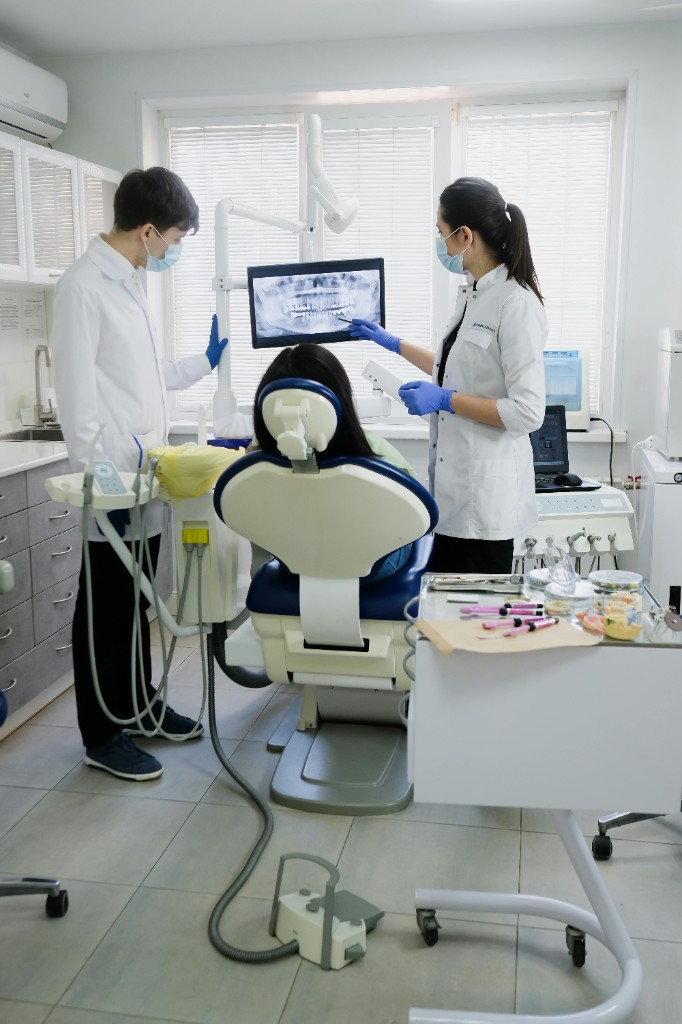
Why sterility is critical
In dentistry, the doctor works with blood and saliva — so any error in sterilization can lead to infection transmission: hepatitis, HIV, herpes. Unfortunately, many small clinics cut corners precisely here — because proper sterilization is expensive and time-consuming.
At DentClinic we built our process according to the EN ISO 17665 protocol — the European standard for medical institutions. Every instrument goes through 5 processing stages and cannot be used without confirmed sterility.
How we sterilize instruments
Stage 1. Disinfection
Right after the procedure, instruments are placed in a solution that kills most bacteria and viruses. Safe for staff and instruments.
Stage 2. Ultrasonic cleaning
Ultrasonic waves clean the instrument from microparticles in hard-to-reach areas — where a regular brush cannot reach. Critical for complex tools: endodontic instruments, burs, scalers.
Stage 3. Packaging
Clean instruments are placed in individual kraft pouches with indicators. The indicator shows the instrument actually went through sterilization (and not just "sat in the cupboard").
Stage 4. Autoclaving
Sterilization with pressurized steam at 134 °C. Destroys all forms of microorganisms, including spores. We use class B autoclaves — the safest on the market (Melag, Germany).
Stage 5. Control and storage
Every autoclave cycle is verified with a biological indicator (weekly) and physical indicator (every cycle). Sterile pouches are stored in a closed cabinet until use — no longer than 6 months.
What we use as single-use
- Gloves and masks — a fresh pair for every patient
- Saliva ejectors and suction cannulas
- Needles and syringes for anesthesia
- Anesthetic carpules — individual, in sterile packaging
- Endodontic files for canal treatment (for safety and precision)
- Patient cups and bibs
- Protective films on the lamp, handles and unit buttons
What we do additionally
- UV office disinfection. After each patient the office is irradiated with a UV lamp — kills viruses in the air.
- Autonomous water supply. Distilled water is supplied to the dental unit, not tap water — to eliminate infection risk.
- Regular checks. The Ministry of Health laboratory takes samples quarterly — required for all clinics, and we always pass without remarks.
- Staff training. Each employee takes an annual infection-safety course.